
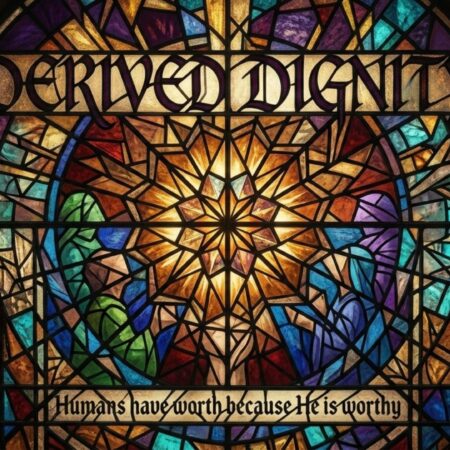
In this message, Pastor Matt argues against MAiD, giving these four reasons why: 1. Christ gives purpose to our suffering 2. MAiD violates the sixth commandment 3. MAiD usurps God 4. Suicide is condemned by example in the Bible
Derived Dignity: MAiD in the Shadow of the Cross
Thanks be to God for His Word, which is always good and precious to us.
I am constantly reminded of an incident that happened early on in my preaching ministry. One of the first books of the Old Testament I preached through was Genesis. Early on in the book, I thought it wise to preach a sermon on our responsibility to care for God’s creation. Because this was a while ago, I made a play on words and called it “An Inconvenient Sermon,” playing on Al Gore’s documentary An Inconvenient Truth.
My elder, Len Friesen, shouted out from the back, “Every sermon should be inconvenient!” Which is true. Let’s pray.
Oh Lord God, I pray that we would hear Your voice. We would listen to Your Word and that our hearts would be shaped deeply according to it, reflecting both Your truth and Your grace through Your Son. In Jesus’ name, Amen.
The Centrality of Jesus Christ
Christ is kind. Christ is faithful. He invites each person:
“Come to me, all who labor and are heavy laden, and I will give you rest. Take my yoke upon you, and learn from me, for I am gentle and lowly in heart, and you will find rest for your souls. For my yoke is easy, and my burden is light.” (Matthew 11:28-30)
In issues that often produce more heat than light, let us ensure that our burdens remain light in Jesus Christ, and that we have the heart of Christ to match His commandments.
First of all, we must see that Christ offers you Himself today. In Christ, there is forgiveness, rest, and eternal life. All a person needs to do is come to Him: repent of self and sin, believe in Jesus Christ, and follow Him as Lord. You do not need to live with the guilt of this world. You do not even need to change the world; all you need is Jesus.
We cannot miss the centrality of Jesus Christ, especially when dealing with issues of justice. Whether it is racial justice, care for the poor, abortion, or—as is the case today—Medical Assistance in Dying (MAiD), it is easy to forget to keep Christ at the center. We cannot forget that Christ is the one who offers us rest, forgiveness, and a better way to live.
As we discuss MAiD, let us recognize that when we come to Jesus, He offers us not just a “ticket to heaven,” but a way to live, a way to suffer, and a way to die with Him. If you accept Jesus Christ today as He is offered in the gospel, every sin you have ever committed, no matter how dark, is wiped away—thrown into the bottom of the sea, never to rise again.
But there is even more to the gospel than just the forgiveness of sins. You receive all the gifts of Christ, primarily the gift of the Holy Spirit, through whom all other gifts come. You receive the gift of adoption, by which we cry, “Abba, Father.” And you also receive the gift of suffering for and with Christ.
You might think, “Man, maybe that’s not the gift I want. Suffering wasn’t on my inventory.” Yet, scripture speaks of suffering as something granted to us: “For it has been granted to you that for the sake of Christ you should not only believe in him but also suffer for his sake.” (Philippians 1:29).
Being joined to Christ by faith—our union with Christ—links us to Him in such a way that our suffering has a good purpose, just as His suffering had a good purpose. My aim today is to show you that we should not cut short our lives or our suffering through MAiD. I am speaking specifically to believers today, because an unbeliever’s suffering is not actually cut short by MAiD; it is merely a doorway to a different and far worse suffering for eternity.
Here are four reasons why you should not accept MAiD or counsel others to do so.
Reason 1: Christ Gives Purpose to Our Suffering
Our union with Christ means we can be assured of resurrection and eternal life because He leads the way. However, because He leads the way, we can also be assured of suffering. Yet, just as His suffering had a purpose, our suffering in Him also has a purpose. This connection is a monumentally important theme in the New Testament.
In 2 Corinthians 4, Paul writes:
“…always carrying in the body the death of Jesus, so that the life of Jesus may also be manifested in our bodies. For we who live are always being given over to death for Jesus’ sake, so that the life of Jesus also may be manifested in our mortal flesh.” (2 Corinthians 4:10-11)
We are given over to death for Jesus’ sake so that His life may be displayed in our decaying, mortal flesh. In short, a Christian’s suffering displays Christ in a unique way. Therefore, when God allows us to suffer, we have an opportunity—perhaps even an obligation—to grow closer to Him and display Christ to the world in a way that would be impossible otherwise.
MAiD, by unlawfully cutting suffering short, removes this opportunity to show Jesus Christ. I use the word “unlawfully” because there are lawful means to alleviate suffering. We do not teach that we should suffer as much as possible for suffering’s sake. Proverbs 31:6-7 says:
“Give strong drink to the one who is perishing, and wine to those in bitter distress; let them drink and forget their poverty and remember their misery no more.”
There is a proper place for medications that dull the senses when someone is physically suffering and close to death. Let the dying have their morphine; there is nothing in the Bible against that. We do not suffer for suffering’s sake, but we do suffer for Christ’s sake.
Just as Jesus showed His true messianic character by suffering death on a cross, Christ’s church displays that same character by suffering faithfully while looking to God. Paul even identifies suffering as a necessary condition of the Christian life in Romans 8:17, noting that we are heirs with Christ, “provided we suffer with him in order that we may also be glorified with him.”
Paul identifies his own sufferings so closely with Christ that he says in Colossians 1:24:
“Now I rejoice in my sufferings for your sake, and in my flesh I am filling up what is lacking in Christ’s afflictions for the sake of his body, that is, the church.”
There is nothing lacking in Christ’s afflictions on the cross regarding atonement for sin. It is finished; every sin is forgiven. Yet, as Christ’s body on earth, our suffering uniquely displays His death and resurrection to the world.
Your suffering as a Christian is never pointless. As we suffer while looking to God, it demonstrates the worth and power of Christ in our mortal flesh, even as that flesh perishes. MAiD—which is a euphemism for medical professionals administering the same lethal injections given to death row inmates—shortcuts this opportunity. We must not accept MAiD because it falsely offers freedom from suffering. God works all things for His glory and our ultimate good, and we should not shortcut His purposes through sinful means.
Reason 2: MAiD Violates the Sixth Commandment
Exodus 20 commands, “Thou shalt not kill.” MAiD intentionally ends a human life, and biblically, that is defined as murder.
Obviously, the intent of both the patient and the medical provider is usually rooted in mercy. However, this is still a person made in the image of God whose life we cannot rightly end.
Consider King David. When his enemy Saul was vulnerable in a cave, David’s men urged him to strike Saul down to save a lot of trouble. Later in life, a wounded Saul asked someone to end his life. Yet David recognized the sanctity of life, asking how anyone could stretch out their hand against the Lord’s anointed. We cannot end a life made in the image of God, because doing so is an assault on God Himself.
Reason 3: MAiD Usurps the Sovereignty of God
MAiD takes God’s place in dealing out life and death. This is perhaps the most serious consequence of accepting its principles. Even secular critics point out the escalating problems with MAiD. You can easily find stories of 20-year-olds receiving MAiD because the complications of a manageable disease like Type 1 diabetes made their lives feel unbearable.
Early on, when MAiD was still new in Canada, a pastor friend of mine in downtown Winnipeg worked closely with the unhoused community. He knew a man living on the street who did not have a terminal illness; he was simply severely depressed, difficult to deal with, and lonely. Tragically, doctors signed off on his request. My friend went with him to the facility, praying with him to accept Christ before he entered the room. The man went into the room alive and came out dead. My friend had to take a one-year leave of absence afterward because of the trauma.
It becomes incredibly difficult to convince a 16-year-old that suicide is wrong when they are in emotional pain, while the government simultaneously assists adults in dying because of physical pain.
Let’s steelman the strongest argument for MAiD, because this is not a far-off political issue—this is about how we handle our last days. Suppose you are severely disabled, in intense pain, and told you have only a few weeks to live. Why not shortcut the pain?
To be vulnerable with you, I have sat at hospital bedsides multiple times and prayed, “God, why not take them now? This is stretching out forever and it is hard on everyone.” The desire to end suffering is a merciful impulse. A psychiatrist who helped design the MAiD program at a University of Toronto hospital summarized the core tension well:
“I struggle more with people who aren’t dying and want MAiD. I think then you’re assisting suicide. If you’re not dying, if I didn’t give you MAiD, you wouldn’t otherwise die. Then you’re a person who’s not unhappy with how you’re going to die. You’re unhappy with how you’re living.”
Once you open the door to purposely ending lives for one reason, it becomes almost impossible to close it to others. MAiD fundamentally alters humanity’s relationship with life and death. Life and death are no longer things that God or providence decides; they become matters of human autonomy and willpower.
The Christian worldview dictates that life is a gift, not a choice. God allocates our days; He gives breath and He takes it away. MAiD asserts that mankind can end life whenever it wishes. This is self-idolatry. It places the autonomous individual where only God belongs.
In a culture where Silicon Valley billionaires try to upload their consciousness into the cloud to live forever, it is ironic that MAiD is so popular. Both impulses stem from the same desire: an illusion of control over death. If we cannot defeat death, we try to take it into our own hands. But scripture teaches: “The Lord gave, and the Lord has taken away; blessed be the name of the Lord.” (Job 1:21).
Because we have medicalized the end of life, we can extend existence in ways past generations could not. This sometimes extends pain and creates complex ethical dilemmas. I do not want to oversimplify this. While we must not actively cause death, we should provide dignified hospice care. As you age, you should have honest conversations about Do Not Resuscitate (DNR) orders. You do not always have to opt for that last round of chemotherapy. If you have made peace with your Maker, you can choose to go home and pass away with less medical intervention.
Similarly, when a body is kept alive purely by machines with no hope of recovery, letting nature take its course is different from actively causing death. We do not play God by artificially extending a body’s life when the systems have shut down, nor do we play God by hastening death. As Christians, we are not our own; we were bought with a price. We must humbly submit to God’s providence.
Jesus had a unique relationship with death because He is the only person who possessed the inherent authority over life and death. He said:
“For this reason the Father loves me, because I lay down my life that I may take it up again. No one takes it from me, but I lay it down of my own accord. I have authority to lay it down, and I have authority to take it up again.” (John 10:17-18)
We do not have authority over our own lives; only God does. James reminds us of the posture we should hold:
“Yet you do not know what tomorrow will bring. What is your life? For you are a mist that appears for a little time and then vanishes. Instead you ought to say, ‘If the Lord wills, we will live and do this or that.'” (James 4:14-15)
Reason 4: Suicide is Condemned by Biblical Example
The Bible provides several prominent examples of suicide: Abimelech, Saul, and Judas. This is not a list of righteous individuals. Both Saul and Judas are explicitly described as being tormented by evil spirits. Satan hates life, and suicide reflects that hatred.
When Saul was wounded in battle, he begged his armor-bearer to kill him so his enemies wouldn’t mistreat him. When the armor-bearer refused, Saul fell on his own sword.
MAiD is often marketed using a similar logic: “Why don’t you spare your family the burden of taking care of you by leaving quickly?” This is a lie from the enemy. First, we are called to bear one another’s burdens, even when it is difficult. It is a blessing for your family to serve you in your weakness. Second, this is the exact same whisper Satan uses on every suicidal person: “It would be easier for everyone if I were just gone.” Your life has a purpose that transcends mere convenience or simplicity. We are called to love, serve, and faithfully endure the realities of God’s providence.
The Calling of the Church
What can the church do practically?
First, we must refuse to participate in or counsel others toward MAiD. Second, we must recognize that the demand for MAiD is frequently driven by senior loneliness and systemic isolation. We address this by actively caring for the elderly and the vulnerable.
This Sunday, our church is visiting Echo Lodge at 2:00 PM. Even when we feel tired, it is an opportunity to bring joy to people who are often overlooked by society. Instead of living highly individualistic lives, we should consider closer family integration. 1 Timothy 5:8 warns:
“But if anyone does not provide for his relatives, and especially for members of his household, he has denied the faith and is worse than an unbeliever.”
This instruction applies to our elderly relatives just as much as it does to the poor.
To remain resilient against the cultural pressures of MAiD, we must look firmly to the cross. Jesus said, “If anyone would come after me, let him deny himself and take up his cross and follow me.” (Mark 8:34).
Why does God allow intense suffering near the end of a believer’s life rather than taking them home instantly? In our union with Christ, those final moments of physical brokenness allow us to be conformed most closely to the image of Christ on the cross. When we look to Him in those moments, there is a profound grace attached to it.
I saw this beautifully illustrated in a dear friend of ours, Kristen Serger, who passed away from bowel cancer. It was a brutal illness marked by immense suffering and loss of physical dignity. Yet, as she neared death, her faith caused the light of Christ to shine through her in an unforgettable way.
That is our calling: to look so deeply to Christ that instead of choosing a shortcut, we walk through the valley being conformed to His cross. I pray that we would maintain that exact same witness in our deaths—not by embracing the artificial escape of MAiD, but by embracing Christ and His cross. Let us experience a death remade in the shadow of the cross.
Amen.