
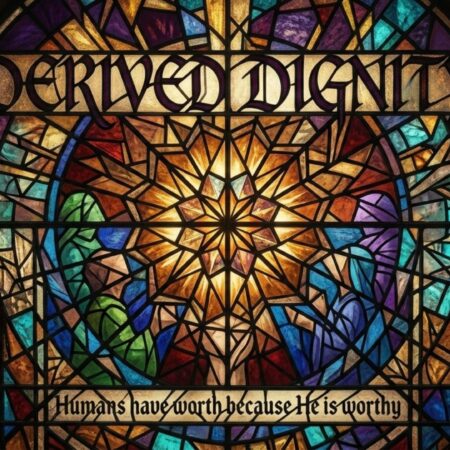
In this message, Pastor Matt explains why defending the lives of unborn children reflects God’s love and care for everyone made in his image, and why abortion is wrong.
Derived Dignity Part Two: Received, not Conceived
In 1987, a young black woman found herself pregnant in a hard place—not done with her college degree, uncertain about her relationship—and so she made an appointment with a Planned Parenthood clinic. She drove into the parking lot, turned off her car, and froze for just one second. And in that moment, there was a war within her. All of her uncertainty about the future. Two lives before her: one where she could keep on doing her school and whatever choices she made, and another with all of the difficulty and trials and many years of motherhood. She could walk into the clinic and move on with her life.
Or, in this moment, which she describes as the presence of the Holy Spirit moving within her, with hardly a thought, she slipped the car back into drive and drove off. And on March 14th, 1988, a baby came into the world. If you’re a basketball fan, you might recognize the name of Steph Curry—a life that was a long shot before he became famous for making long shots.
Last week we talked about the value of human life: that we should love, protect, and defend human life. Not because it is easy, not because it is always practical, not because it’s a benefit to ourselves or to society, but because every person—whether young or old, whether able or disabled, whether easy to get along with or deeply annoying—is created in the image of God. They are worthy of dignity and respect and life, not because of anything they have done or will do, but because they are made in God’s image, and we honor God by respecting them.
Today we extend that discussion to the smallest and most vulnerable: the baby in the womb. Now, I don’t want to assume anything, but I want to show you that elective abortion is unlawful killing and deeply opposed to God’s law. It is an assault on people who are made in the image of God—people who should be protected regardless of their size, ability, disability, and regardless of how inconvenient they might be to an individual or society.
Let’s pray.
Lord God, I pray in an issue often clouded by political fog that you would give us clarity to see life as you do: as a gift. I pray that you would help us to be compassionate and love all people regardless of their size, ability, or choices they make, and that we would respect not just them, but the image of God that they represent. In Jesus’ name we pray. Amen.
On one hand, talking about abortion is very easy just to begin with a simple syllogism based upon Exodus 20:13: “You shall not murder.” * First: Murder is intentionally ending a human life. Intentionality is important; obviously, the law has exceptions for accidents.
- Second: A baby in the womb is a human life.
- Third: An elective abortion intentionally ends a human life.
- Therefore: Elective abortion is murder.
There is only one really important question that matters in talking about abortion. People who advocate for abortion will talk about every subject under the sun. They will talk about the parenting, or the poverty of the parents. They will talk about the unfairness and burden it places on women—both of which are true. They will talk about reproductive freedom. They will write long and boring novels about women forced to have children.
But there’s only one question that matters in the end, and that is: Is this child in the womb a human being created in the image of God, worthy of dignity and protection? Or is it something less, whose rights might be abrogated to ease the life of someone we deem more valuable?
We know that children are hard. Well, if you’ve had them anyways—if you haven’t had children, you might think, “Oh, they’re pretty easy and all these parents are just whining.” No, they’re hard. And as much as sometimes I would rather my two-year-old not exist—sorry girls, those were tough days—we don’t allow fathers or mothers or doctors to kill two-year-olds. We don’t allow them that choice. Everyone agrees that some choices should be limited if it means protecting human life.
As we went through the syllogism—murder is intentionally ending a human life; a baby in the womb is a human life; an elective abortion intentionally ends a human life; therefore, elective abortion is murder—it might seem a little harsh. But this is what it is: the intentional taking of a human life. People might call it reproductive freedom, but it is very clearly anti-reproductive. People might call it healthcare—and this will come up again next week, so pay attention to this term—but healthcare is medicine and practices aimed at the healthy functioning of a human body. Abortion is anti-healthcare because it is working against both the healthy functioning of a woman’s body and her womb, and especially against the healthy functioning of the child that inhabits that womb.
Now, people will say, and they do, take issue with the second point of my syllogism: that a baby in the womb is a human life. They will say it’s a small clump of whatever. The truth is that most surgical abortions happen between 12 and 14 weeks of pregnancy. I just went on the What to Expect When You’re Expecting website and I found an illustration from a Canadian pregnancy guide website which I think is pretty accurate.
If we turn down the lights so people can see: this is a 14-week-old fetus in its stage of development. And “fetus” is just Latin for child; that is what is brought forth. This is what they look like: facial features that are becoming more defined, eyes that have gotten to look like eyes, eyelids that are shut. The baby’s brain has developed to the point where they can make expressions—frowning, squinting, smiling. Old enough to smile, but not old enough to be protected.
I once was at a former church, and they had an exhibit that came around which showed highly detailed photographs of the remains of an aborted 14-week fetus. It’s the kind of thing where you’d have to prepare yourself because it’s the kind of thing that you see and don’t forget. A little arm sitting on a coin to show the size of it. Fingers, fingernails.
The fact of not seeing things becomes, I think, very important in our society because we have trouble forming moral judgments when we can’t see things. We can see the suffering and scared teenage girl—and we should see her, and we should have compassion—but we can’t see the child literally smiling in her womb. If we did, we wouldn’t have to have so many questions about this. This child, although small, helpless, and dependent on its mom for everything—so is a baby that’s six months old. Leave a six-month-old out in the woods, they’re not going to do very well. But we protect the six-month baby, granting them the status of human, but not the 14-week-old in the womb.
The reason we do is because it’s hard. When there are hard things, our society tends to fall back on the two things we talked about last week: utilitarianism and autonomy—what’s easier and what people decide. It becomes really convenient just to flip a switch and pretend like these children aren’t children at all. I don’t want to overlook the difficulty and hardship of birth and motherhood, because those things are unbelievably difficult. I don’t want to overlook the fact that this puts undue work on women especially; maybe we just should take a little bit more care on how much work women have to do in the totality altogether. But if human beings are made in the image of God and worthy of dignity, even when they haven’t done anything, even if they are not wanted by their mothers, they are still worthy of dignity and protection and love and respect. We are commanded not to intentionally kill human life.
Human beings are made in the image of God. “What is man that you are mindful of him, and the son of man that you care for him? Yet you have made him a little lower than the heavenly beings and crowned him with glory and honor.” This being of humans is clearly something that happens before you are born in the Bible. Psalm 139: “For you formed my inward parts; you knitted me together in my mother’s womb. I praise you, for I am fearfully and wonderfully made. Wonderful are your works; my soul knows it very well.” And so every person is made in the image of God. They are His image regardless of their ability, regardless of their self-will. The child with Down syndrome or the elderly person with ALS is worthy of dignity and respect and life, regardless of what they can do or any other capacity, simply because how we treat them matters to how we honor God in whose image they are made.
This is why as believers we must care for the young and old. We must care for the inconvenient or annoying. We stand up even for the rights and dignity of criminals and enemies. “Love your enemies.” Deuteronomy has a whole chapter regarding the rights of the manslayer—someone who accidentally kills someone—to flee to a city, because God wants to make very sure that even criminals have rights and should be respected.
We must stand up for those whose only “crime” is being small, or even just being a girl. One terrible side effect of the current abortion regime in Canada is how many girls get aborted just for the simple fact that they test feminine in utero. I won’t mention their cultural background, but I heard this story from someone who told it of a friend of theirs. It’s from a culture that values boys more than girls. A husband and wife, married, with no children, conceive and go to the doctor. They discover that they are expecting a girl. The husband, not wanting to deal with the pressures of having girls (some of it having to do with dowries and things like that), gets his wife to go and have an abortion. Down the road, she gets pregnant again, goes and gets tested again. It’s a girl again; she aborts the child. A little while later, she gets pregnant again, goes to the doctor, gets tested. It’s a girl again. Aborted.
Seven. Seven girls. So much for girl power. Seven girls created in the image of God. A terrible crime not only against seven children, but against the God in whose image they are made, and a crime against women in general. Not to mention the fact that fewer and fewer children are born with Down syndrome every year—not because we’ve cured it, but because we’ve killed them.
As Christians, we defend life because we follow God’s command not to murder. We defend life because every life, no matter its development, no matter its ability, no matter how inconvenient it is, is worthy of protecting because it is made in the image of God. An assault on them is an assault on heaven itself because of God’s infinite worth and dignity.
If we really know Jesus Christ—and I pray that we do—hang on with me before we get to the end. We should know this very well because Jesus Christ, our Savior, God in the flesh, came down not on a cloud, not in a chariot, but through the womb of a young, unwed mother. And the prophet of that Savior, John the Baptist, as a person, leaped in his mother’s womb upon meeting that Savior. How could we not believe that every child, once conceived, is worthy of life and protection and love when our beloved Savior was once an infant just as they?
Just to catch up so that we haven’t skipped too quickly:
- Murder is wrong.
- The life in the womb is created in God’s image.
- Our Savior was once an embryo.
“And when Elizabeth heard the greeting of Mary, the baby leaped in her womb.” The baby John the Baptist, in his first act as a prophet—mind-boggling. “And Elizabeth was filled with the Holy Spirit, and she exclaimed with a loud cry, ‘Blessed are you among women, and blessed is the fruit of your womb!'” There are two very specific things you see here: first, that John the Baptist, when he was six months in his mother’s womb, was not only a person but a person who responded to the Savior. Secondly, Jesus, before He is born, while He is still in the womb of Mary (probably three months or so), is called the blessed one because even at this young stage of development, He is the God-man—fully human, fully divine, created in the image of God, the firstborn of all creation.
This is why, very early on, one of the church’s first big cultural stands was against the exposure of infants and abortion. You can find it in a couple of different places, like the Epistle of Barnabas: “Thou shalt love thy neighbor more than thy own life.” That is Christian morality—you need to love your neighbor more than you love your own life. “Thou shalt not slay the child by procuring abortion, nor again shalt thou destroy it after it is born.” The case against elective abortion is absolutely clear in that we are called not to murder any human being, regardless of their ability, because they are made in the image of God, worthy of respect because of God, not because of anything they have done. The narrative of our Savior’s birth shows His humanity and John the Baptist’s humanity while still being in the womb.
Now, there is some nuance here that we should probably address in dealing with difficult issues. There are occasionally situations where a pregnancy has a very high degree of risk of ending both the child’s life and the mother’s, the most common of that being an ectopic pregnancy. In such cases, ending a pregnancy might actually be healthcare in that its end is protecting the one life that it can protect. But we shouldn’t use edge cases to justify all cases.
Even in the case that you will get if you have this conversation—and I have many times—what about the woman who was raped? As evil as rape is, which it is, it is never the child’s fault. Even children who are mistakes are beloved by God, made in His image, and worthy of protection and respect. I’m in favor of hanging rapists but protecting children, even realizing the hardship it might cause.
The third nuance—and it’s actually not nuance, it’s just going all the way—is that it raises the question of where life begins. We can look at a picture of a 14-week-old and see that this is a child. It has fingernails, a heartbeat, and a smile. But what if you go back to 12 weeks, or 8 weeks, or 4 weeks, or to an embryo? An embryo of 18 cells or so.
Here again, an embryo is a unique person. Each one of us today once was nothing but an embryo. Every cell in your body that has your DNA has grown from that embryo. And so I believe embryos are made in the image of God, worthy of protection, respect, and dignity. This calls into question all sorts of things, especially with IVF. If you haven’t looked into the morality of IVF, you should.
I want to get into an issue for just a moment that’s going to become increasingly important. We’re not going to spend time on it, but I just want to put it on your radar because there are companies that are beginning to offer genetic testing on embryos. Right now, they say they’re screening for abnormalities—Down syndrome, Huntington’s disease, cancer risk. But this technology will be used, if it hasn’t already, to screen for things like intelligence, hair color, and the like. This is going to be an issue very quickly.
My plug against this is that separating bringing children into the world from the deep, loving marital union between a husband and wife does injustice to the way that God created the world. I believe that healthcare should be ordered towards restoring right function, and infertility should be treated in ways that work in harmony with God’s design instead of outside it—especially when it produces embryos that sit in freezers indefinitely. Okay, side note done. Back to abortion.
I hope that I’ve shown the wrongness of it, that it is a kind of murder. And I hope to show that in Jesus Christ, no matter what sin they have done, we can look to Him with hope, forgiveness, and reconciliation for those who have been sold a lie from a culture around them that wants to paint over that picture.
So what can we as a church do about this? Five things:
1. Advocate justice for all
If this was the US, I would give my warning here about being married too much to one political party. But in Canada, that’s not much of an issue because there’s no major party that cares about the unborn in their platform. I don’t know what the future is, but we should care for and advocate for the protection of all people, no matter their size, development, skin color, gender, or anything. We must stand up for justice in ways that do justice to the fact that even those who have and even those who perform abortions are also created in the image of God and worthy of a kind of respect for that. We should holistically care about people and advocate for the protection of all people from unjust killing. I’ve said it before that the moral law should be the basis for just law. And so I believe that abortion should be illegal, just as I believe that killing anyone should be illegal. This is how I vote, even though I always feel like I’m compromising with every vote in some way.
2. Give practical support for moms
Remember James 1:27: “Religion that is pure and undefiled before God the Father is this: to visit orphans and widows in their affliction, and to keep oneself unstained from the world.” This is something that Options Pregnancy Care Center does, which we’re fundraising for right now. We want to be able to give options to people who feel like they don’t have options. The fact is, a lot of women who get abortions kind of maybe would like the child but feel like they can’t. The church should be a place to give hope for those people. We want to be the place that makes it easier for moms, young moms, women, and single moms to care for and raise their children. We should be the ones who are first in line to adopt, to do foster care, and to care for the environment—not just of our own children, but for the children in our wider community.
3. Talk about it
We should be prepared to talk about this evil in winsome and convincing ways. We need to clarify the one and only issue: that it is not about privacy, it’s not about healthcare, and it’s not about reproductive freedom. It is whether a fetus in the womb is a human life created in the image of God. There’s a very simple argument, and I’ve already kind of made it. The simple line is to “trot out the two-year-old.” The two-year-old is small, undeveloped, and unable to live without care. Although it is larger and more developed than the 14-week fetus, the difference is only in degree and not in kind. If you’re interested in learning more, read The Case for Life by Scott Klusendorf, which I have and you can borrow.
4. Engage in less political demagoguery and more brokenhearted prayer
We need to pray like Daniel: “We have sinned and done wrong and acted wickedly and rebelled, turning aside from your commandments and rules.” We need to mourn the loss of life. We need to cry out to God for mercy on this nation for this great evil. We need to cry out to God to deliver the weak and perishing. We need to pray for justice in our land and our world. Come, Lord Jesus. It can feel hopeless, but one day there will be a reckoning, and one day justice is coming in our Lord Jesus Christ.
5. Build strong families
In our attitudes, we must promote that children are truly a blessing of the Lord, as Psalm 127 says. It’s a little bit shocking if you look up the statistics and you realize that 10% of abortions are from married women—hardly the stereotype. But if we have strong families, this is what protects women from making terrible choices. In promoting strong families, we see that pregnancy is seen as a gift and a blessing rather than seeing female fertility as some curse to be overcome.
Every person who has ever lived is a statue representing God. An assault on that person’s dignity and life is an assault on the Almighty Himself. Therefore, we should stand opposed to anything that would demean or diminish people who are created in the image of God, all the way from racism to unjust warfare to the terminating of babies in the womb.
I truly believe, in closing, that the one thing that keeps abortion legal is not the arguments. I believe that it is primarily about shame. Statistics would tell us that somewhere close to one in three women have had an elective abortion—maybe 30%, maybe a little lower. To admit wrong in this, to say abortion is really wrong, is hard to say because it would incriminate millions.
But this is where we have to see as a church what the gospel really is. Because even as I’ve talked about how terrible the sin of abortion is, I am also a sinner in ways that are different but no less heinous. In Jesus Christ, if we truly believe the gospel, we cannot come to this issue heaping shame and judgment on others. Instead, we must come to this issue with the same heart and mercy of Jesus Christ, who calls out both to us—both to the woman who has had an abortion and to the abortion doctor: “Yes, you are a sinner. Yes, this has been a terrible sin. But yes, I offer forgiveness and grace. Yes, you can come to me and truly pray, ‘Father, forgive me,’ and it is forgiven.” You can lay down the shame and guilt that has been carried with you through your life and turn again to God your Father. You can live now in hope—not of judgment in the future, but of vindication and mercy because of the cross of Christ. And you can hold onto the hope that one day, you will once again see the child that you never got to see because of your choice, believing that God can knit these things back together again in His kingdom to come.
Let’s pray.
Oh Lord, we look to you for mercy, for all of us have sinned and fallen short of the kingdom of God. And so I pray that our attitudes would not be lifted up in some haughty political way, but we would bow down recognizing that we are sinners alongside of any sin that we have ever called out. And so we look to the grace of the Lord Jesus Christ to forgive us again, to renew us again, to walk in freedom and life, and to protect the widow and the orphan, to rescue the perishing, to stand up for the rights of the smallest to the greatest, to stand up for the rights of those when it is politically inconvenient to do so. We pray that human life would be honored because ultimately it is made in your image, and it will honor you, our God and our king. In Jesus’ name we pray. Amen.